Kuzushiji OCR
Does a recurrent layer help read cursive Japanese sequences, and does the help grow with length?
- Context
- Deep Learning coursework, individual
- My part
- Everything: data composition, both models, evaluation
- Stack
- Python, TensorFlow, Keras, CTC, BiLSTM
- Year
- 2026
38.4% vs 34.8%
Exact sequence accuracy, CRNN-CTC vs CNN-CTC, on 3,000 held-out sequences
- What it is
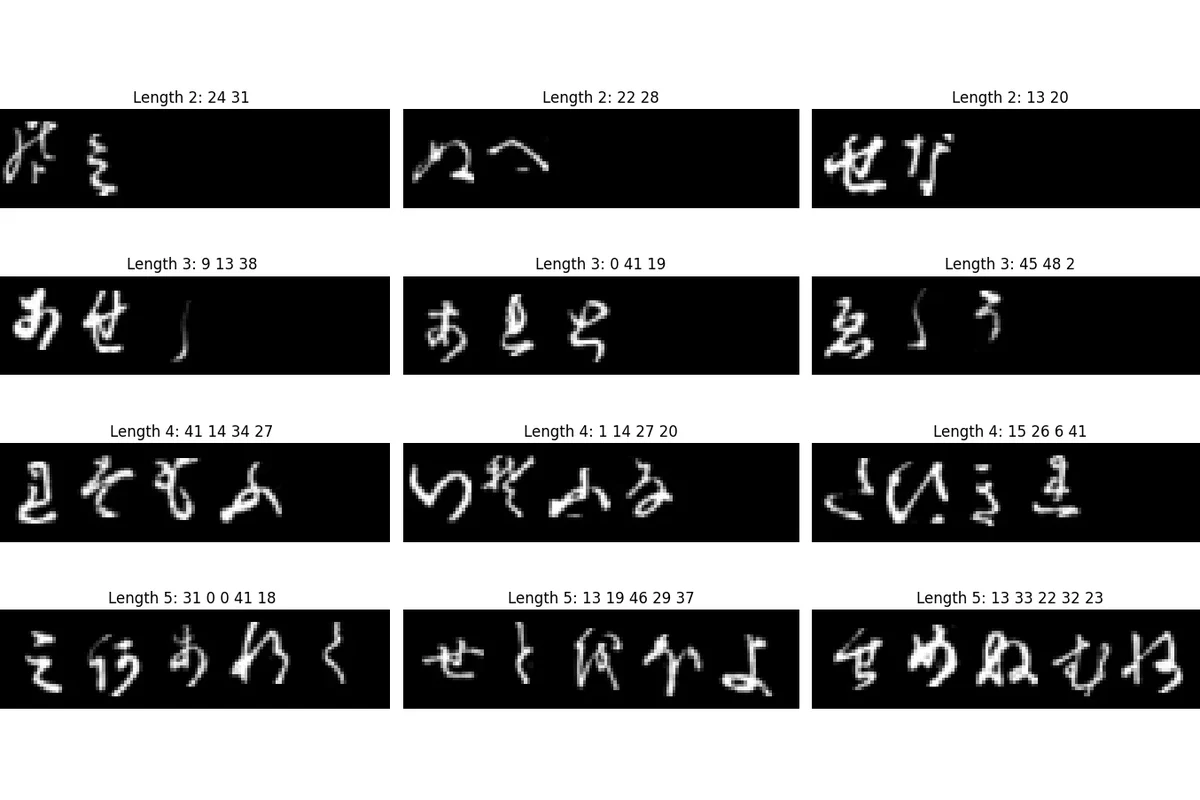
- Sequence recognition without character boundaries: 32×128 images of 2 to 5 Kuzushiji characters, composed from disjoint glyph pools and balanced across lengths.
- What I did
- I built a CNN-CTC baseline and the same model with a 64-unit bidirectional LSTM added, so the recurrent layer was the only difference, then compared them by length and error type.
- Result
- The BiLSTM cut character error by 10.4% and deletions from 442 to 52, and helped at every length, most at length 4, so the length hypothesis is only partly supported. It cost 60% more parameters and 4.5 times the training time.