Handwritten Letter CNN
Twenty-six handwritten letters, from a dense baseline to a locked CNN.
- Context
- Deep Learning coursework, individual
- My part
- Everything: data checks, experiments, error analysis
- Stack
- Python, TensorFlow, Keras, CNN
- Year
- 2026
The problem
Twenty-six handwritten letters as 28 × 28 grayscale images, and a model that should tell them apart. It is the simplest project here, so the interesting part isn’t whether a CNN can do it. It is how much of the final score each decision earned, and whether the mistakes that remain are the model’s fault or the handwriting’s.
The data wasn’t what it said
The file had 99,040 rows, 9,465 of them exact duplicates. Following the duplicates led somewhere more useful: almost all of them carried labels −1 and −2, which aren’t letters. Viewed as images, those 10,240 rows were blank, uniform or corrupted with a few stray marks, and they also accounted for every blank image in the file.
Removing the two invalid labels removed the duplicates and the blanks with them, leaving 88,800 rows across 26 balanced classes, with only 2 duplicates left.
Earning each step
Each change was a controlled experiment on the validation set, chosen on macro F1 so a weak letter can’t hide behind strong ones. The test set was used once, at the end.
Always predict the most common letter
Validation macro F1 0.003
Dense network on flattened pixels
Validation macro F1 0.881
First CNN, keeping the 2D layout
Validation macro F1 0.911
Tuned batch size and epochs
Validation macro F1 0.930
A third convolution block (32, 64, 128 filters)
Validation macro F1 0.937
Dropout 0.7 before the dense layer
Validation macro F1 0.946
Batch normalisation; augmentation
Validation macro F1 Tested, not kept
| Step | Validation macro F1 |
|---|---|
| Always predict the most common letter | 0.003 |
| Dense network on flattened pixels | 0.881 |
| First CNN, keeping the 2D layout | 0.911 |
| Tuned batch size and epochs | 0.930 |
| A third convolution block (32, 64, 128 filters) | 0.937 |
| Dropout 0.7 before the dense layer | 0.946 |
| Batch normalisation; augmentation | Tested, not kept |
Dropout of 0.7 is high, and it was treated as an underfitting risk, but it came out of a sweep rather than a default, and L2 regularisation alone topped out at 0.925. On the held-out test set the final model scored 94.95% accuracy and 0.949 macro F1.
Where it still goes wrong
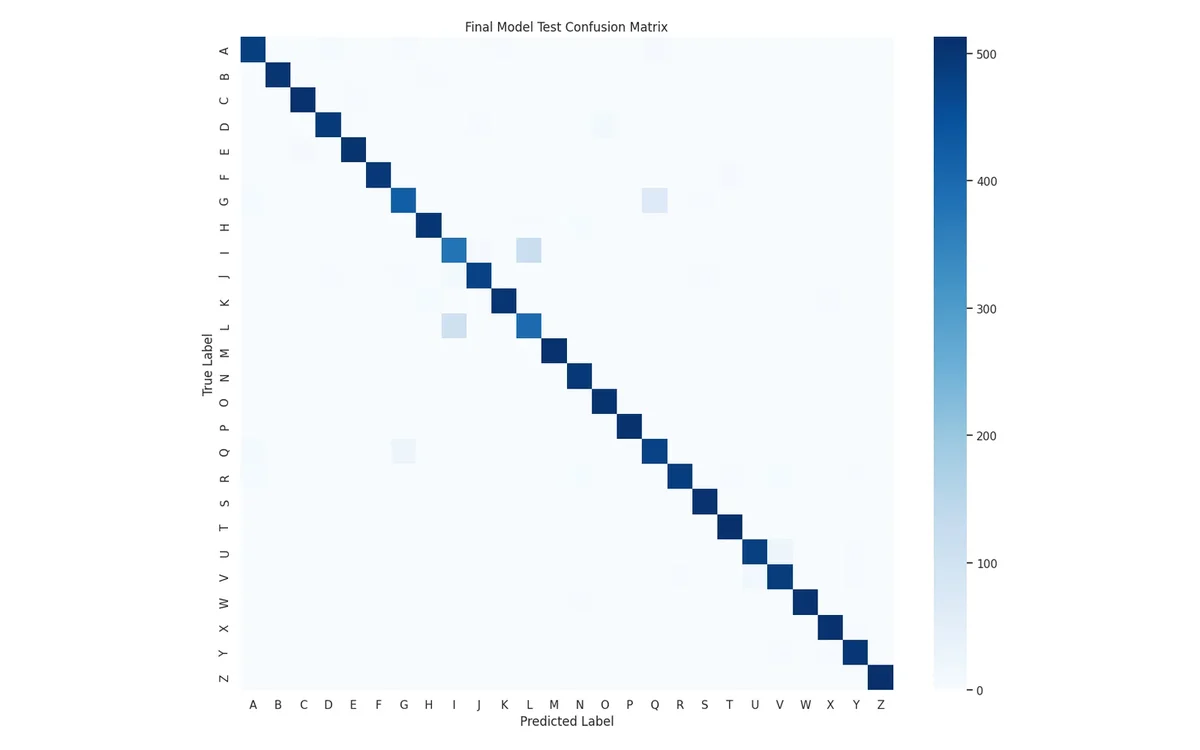
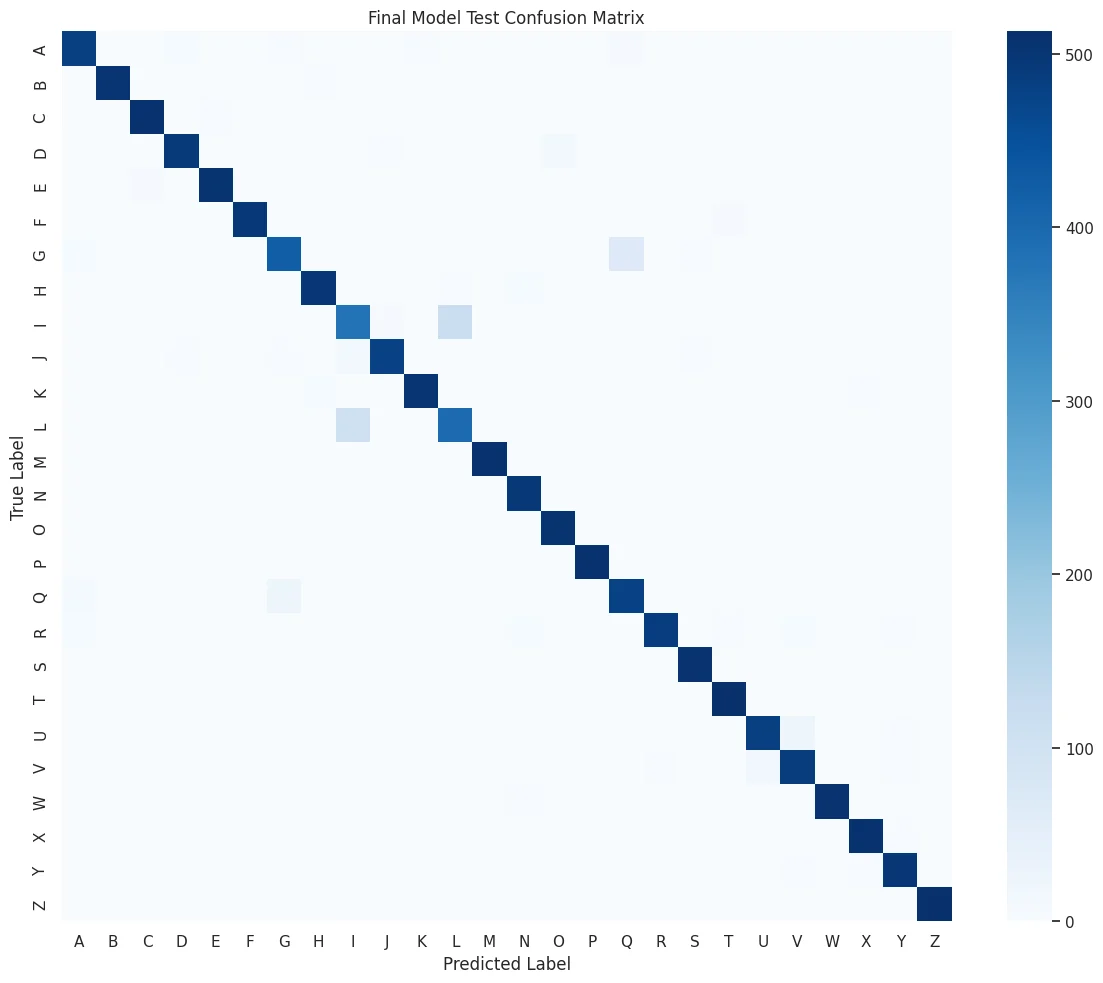
Before training anything, the average image of each class suggested which letters would be confused: I and L, G and Q, O and Q, U and V, M and N. The final confusion matrix confirms most of that list. The biggest remaining errors are I with L, G with Q, and U with V, pairs that are often ambiguous to a person too.
Feature maps and misclassified examples are in the notebook as clues to what the network responds to, not as proof of why it decided anything.
Test confusion matrix
Decisions
Follow the duplicates to the cause
Dropping 9,465 duplicates would have tidied the symptom. Tracing them to two labels that weren’t letters removed corrupted images the model would otherwise have been trained and tested on.
Beat a real baseline, not a strawman
A dense network already reaches 0.881. Showing it first makes the CNN’s gain honest: convolution adds three points of macro F1, not ninety.
One change per experiment
Protocol, capacity, regularisation, batch normalisation and augmentation were tested in order, each against the previous best. Every line in the final model can be traced to the experiment that justified it.
Predict the errors before seeing them
Listing likely confusions from the class averages before training turns the confusion matrix into a check of a stated expectation, rather than a story written after the fact.
Results
94.95%
Test accuracy across 26 letters, macro F1 0.949
10,240
Corrupted rows found and removed through the duplicate check
+0.065
Validation macro F1 gained from the dense baseline to the final CNN
Individual Deep Learning coursework on a supplied EMNIST-style dataset. One training run of the final configuration; small differences between the later experiments could change with another seed.
Limits
- A letter classifier, not OCR: it sees one centred letter at a time.
- The remaining errors are on genuinely ambiguous handwriting, where a better model may not be possible from the image alone.
- The dataset’s source and licence weren’t given, so it isn’t in the repository.
Up next
All work